 Kasra Vaziri
Vibe Coding's Bill Is Coming Due for Product Teams
Vibe coding made shipping effortless. Now the maintenance bill is arriving — and it's landing on product teams. Here's what the reckoning means, and how to get ahead of it.
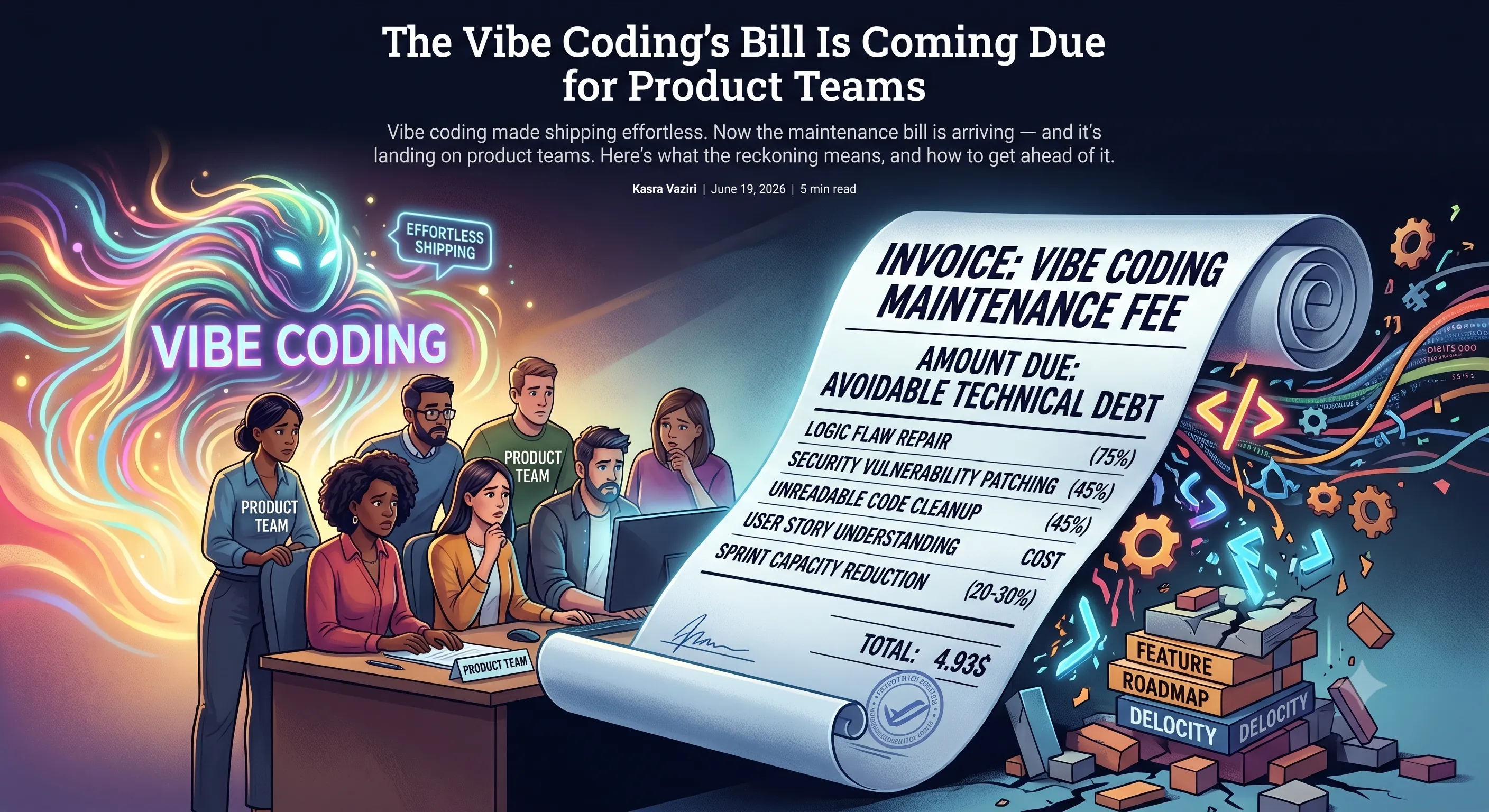
Last week the top question from a frustrated developer on Hacker News was a version of the one every product team is about to ask out loud: a client vibe-coded half the product themselves, it "works," and now nobody knows how it works — or who keeps it running.
That's the moment we're in. Eighteen months ago, vibe coding — describe what you want, let the model write it, ship before you fully understand it — was half joke, half party trick. Now 92% of U.S. developers already use AI coding tools, and AI-assisted development has grown into a multibillion-dollar market. The velocity was never in question. What we're finding out, the hard way, is what it costs.
The bill is coming due. And it's landing on product teams.
The vibe coding honeymoon — and the hangover
Here's the pattern, and you've probably lived it. A feature that used to take two weeks ships in two days. The demo is gorgeous. Everyone's thrilled. The velocity chart goes vertical. For about ninety days.
Then the maintenance starts — and the research is starting to put numbers on it. GitClear's analysis of 211 million lines of changed code found that code churn — the share of new code rewritten or reverted within two weeks — climbed from 5.5% before AI tools to 7.9%, while duplicated, copy-pasted code blocks quadrupled and, for the first time, overtook refactored code. And Veracode's tests across more than 100 models found that roughly 45% of AI-generated code ships with a security vulnerability — about 2.74× the rate of human-written code.
This isn't an argument against vibe coding. The speed is real, and it's not going back in the box. It's an argument for being honest about the trade you're making — because right now, most teams aren't pricing it in. They're booking the revenue and ignoring the loan.
Technical debt is now a product problem
For years, technical debt was something engineers complained about and PMs nodded along to before getting back to the roadmap. That separation is dead.
When Forrester projects that 75% of technology leaders will face moderate-to-severe technical debt by 2026, and McKinsey finds 60% of CIOs say their tech debt has risen — with 10–20% of the budget meant for new products quietly diverted to servicing it — debt has stopped being an engineering line item. It's a product constraint. It decides what you can ship next quarter. It decides how fast your team moves a year from now. It decides whether that "two-day feature" becomes a six-week incident with your name on the postmortem.
The uncomfortable truth: vibe coding moved the bottleneck. It didn't remove it. We used to be limited by how fast we could write code. Now we're limited by how fast we can understand, review, and trust code that wrote itself. Pull requests pile up faster than anyone can carefully read them, reviewers are drowning, and a tired reviewer rubber-stamping AI output at 6pm is exactly how the worst debt gets in.
What this changes about the job
If you lead product, three things are different now — whether you've noticed or not.
Speed is no longer the scarce resource. When anyone can generate a working prototype in an afternoon, the prototype isn't the asset. The judgment about which prototype deserves to become real, maintained software is. Your edge moves upstream — to the decision about what's even worth building.
"Done" needs a harder definition. A demo that works is not a feature that ships. In a vibe-coded world, "done" has to include the boring parts the model skips by default: tests, error and empty states, the security pass, and the question of who owns this in six months. If your definition of done doesn't name those, you're not shipping features — you're shipping liabilities with a nice UI.
Maintenance is a roadmap item, not a tax. The teams that win the next two years will be the ones that put cleanup on the board, in public, with a number next to it — not "we'll get to it eventually." A standing capacity allocation, defended like any other priority. Your team is already spending that time on AI-bug cleanup. The only question is whether you planned for it or got ambushed by it.
How to get ahead of it
A few things that actually move the needle — none of them exotic:
Make the AI explain itself. Don't accept generated code your team can't narrate. If nobody can explain what a function does and why, it doesn't merge. That one rule kills most of the worst debt before it ever lands.
Spend the speed dividend on tests, not just more features. Vibe coding hands you hours back. The highest-leverage place to reinvest them is the coverage and architectural review the model didn't write. It feels slow. It's the opposite.
Track debt velocity, not just feature velocity. If features go up and to the right while bug-fix time quietly climbs, your velocity chart is lying to you. Watch the second number as closely as the first.
Decide what's allowed to be vibe-coded. A throwaway internal tool? Vibe away. The billing system, the auth flow, anything touching customer data? That code earns a human architecture. Drawing that line is a product decision — and it's yours to make.
The real takeaway
Vibe coding didn't make engineering easy. It made starting easy — and quietly shoved the hard parts to the back of the project, where they're more expensive and far harder to see coming. The product teams that thrive won't be the ones that vibe-code the fastest. They'll be the ones that treat the speed as a loan, not a gift, and budget the repayment from day one.
The bill arrives either way. You can plan for it, or you can be surprised by it in ninety days. That choice — not the code — is the part that was always your job.
Sources
GitHub — Survey reveals AI's impact on the developer experience — 92% of U.S. developers use AI coding tools.
GitClear — AI Copilot Code Quality: 2025 Research — code churn and duplication trends across 211M lines of code.
Veracode — 2025 GenAI Code Security Report — ~45% of AI-generated code contains a security flaw.
Forrester, via CFO Dive — The tech debt "tsunami" building amid the AI craze — 75% of tech leaders facing serious technical debt by 2026.
McKinsey — Tech debt: Reclaiming tech equity — 60% of CIOs report rising tech debt; 10–20% of new-product budget diverted to servicing it.
Grand View Research — AI Code Tools Market Report — market size and growth.